.png)


Lauren's Story

The 10-week wall
Lauren could stop drinking, that wasn't the problem. She'd done it before, for years actually, and when things got difficult again, she could still manage periods without alcohol. But there was always a wall.
"I had managed to stop for periods, but 10 weeks seemed to be a tipping point," Lauren says. "I’d get to that point and before I knew it, I’d just be back doing it again."
She had tried everything: moderation strategies, measuring out drinks, self-education, therapy, naturopaths, diet changes, books, apps, podcasts and sober coaches. All the things.
Some of it helped, to a point, but nothing stuck long-term. "I just didn’t know why I couldn’t get past that point." And every time she hit that wall, the shame spiral would start all over again.
The second time around
Lauren had been alcohol-free for years. She'd done the work, found her footing, and moved forward. Then 2020 happened and Lauren went through a marriage breakdown, COVID and a move. So many things changed at once, and drinking slowly crept back in.
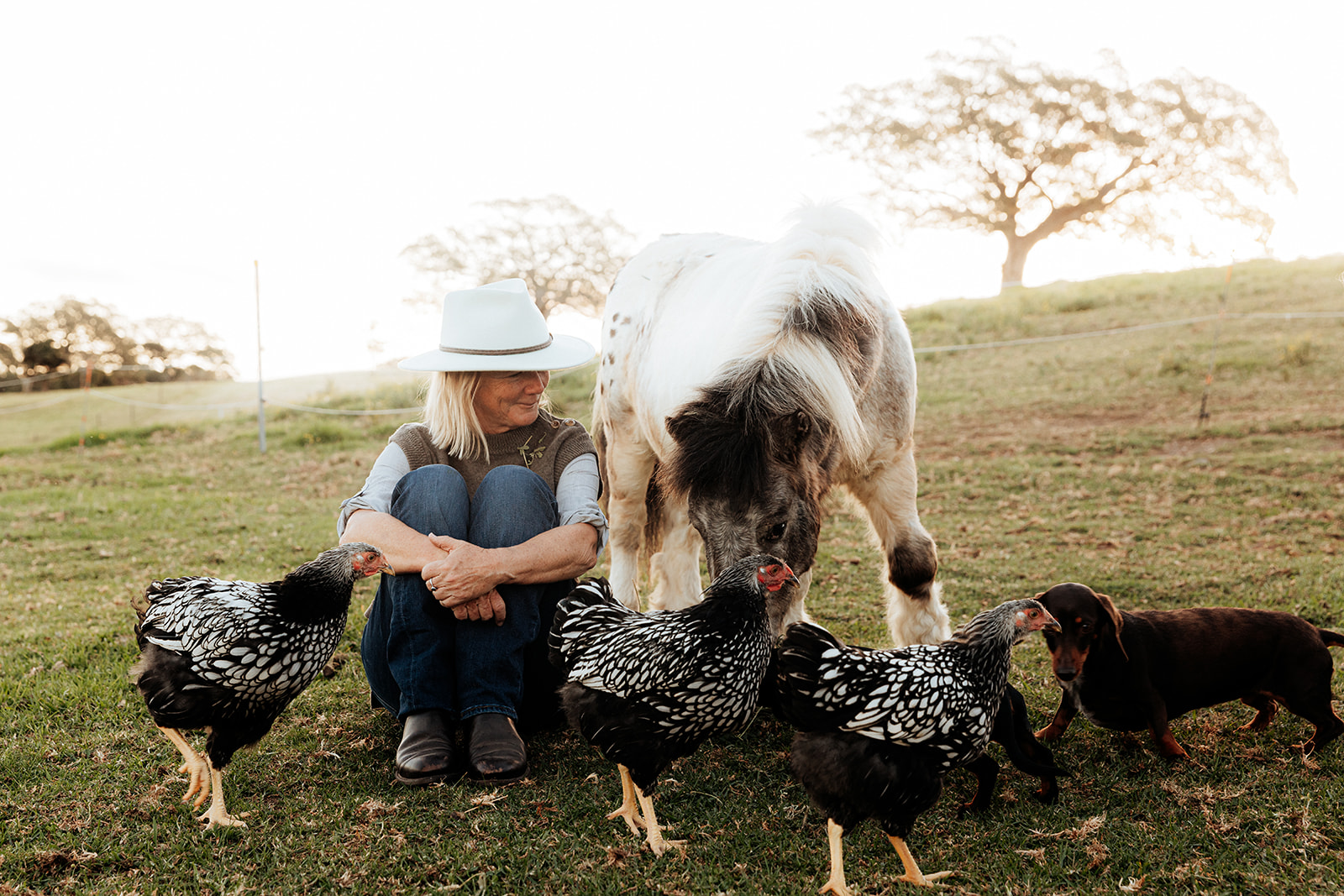
From the outside, Lauren was still functioning. She ran her own business working with horses, supporting people through equine therapy. She showed up for work, held it together, but inside she was falling apart.
"I felt myself becoming unhealthy. I just didn't seem to have the energy and drive that I wanted," she remembers. "And I was definitely isolating myself. It becomes a really private process."
The worst part was the disconnect between how she was supporting others, and how she couldn't seem to support herself.
"The work I do with my horses, supporting people - I don't want to be a fraud. I don't want to be doing this and then running in the door and having a drink. That just doesn't add up for me."
She knew there were other ways to be, to live and to take better care of herself. But knowing and doing felt like completely different things.
The illusion of “willpower”
Lauren kept setting goalposts. "I'm going to be 50 in three months. I'd really like to not be drinking at that point." Fifty came and went, and still nothing changed. Then New Year's, then another birthday - more goalposts she just couldn't meet.
"It puts so much pressure on you, and you’re really hard on yourself for not being able to do it. For not having the willpower, the strength - whatever. You say terrible things to yourself over that inability to change."
It wasn't from a lack of trying. Lauren was always searching, whether it be online, or through different books and programs - she’d constantly be looking for the answer, convinced it had to be out there somewhere.
The 12-month factor
When Lauren found Clean Slate online, a few things drew her in. First the privacy of being able to be at home, the ability to do the maths on what she was already spending versus what it would cost. And most importantly, the 12 months of ongoing support.
"That was the biggest thing for me, knowing that I would have someone for that long-term period. Because I knew three months was okay, but as soon as I went past that point, I was back in deep."
She signed up and soon after received a call from her nurse, Fiona.
Working with Fiona was different from the start - it was a softer approach with no big production. After the preparation phase, Fiona asked: "Have you thought about when you’d like to stop?" Lauren said no, not really. Fiona responded, "Let's just do it tomorrow then."
But it wasn't a straight line from there. Lauren dipped in and out, the pattern she'd always had, except when it happened this time, Fiona helped Lauren to reframe her experience.
"She just took the ‘bigness’ out of it. For once, it didn’t feel like a big deal. And that taught me, and my nervous system, not to panic about it."
Instead, Fiona helped Lauren notice patterns. "How does that feel? What was going on?", she’d say. Constantly assessing that process and what may have been happening. Every check-in, Lauren had something to explore: a course, a book or someone to read about. There was always something to investigate.
"Being curious about the what’s and the why’s is a big part of recovery."
The missing piece
Through their conversations, Fiona had been noticing things - patterns in how Lauren talked about being overwhelmed, about anxiety and the way she approached her work and her life.
"It was almost like sabotage, but it wasn't on purpose."
And then Fiona asked: "Have you ever looked at having a mental health diagnosis? What about ADHD as a possibility?"
Lauren knew there was research around later-in-life diagnoses for women, and she knew that women were often overlooked as children - but she'd never connected it to herself.
"I did some reading, checked it out, and was quite shocked at how my whole life had potentially been affected by this without me knowing. It gave an explanation to so many things."
She found a psychologist, got diagnosed, and started medication. "That was probably the biggest game changer for me."
Because suddenly, the pattern made sense. The 10-week wall made sense. The way she'd been trying to regulate herself through alcohol - it all made sense. She'd been self-medicating without even knowing it.
"As soon as I went through that process and got the diagnosis, alcohol just became irrelevant." It was the final piece of the puzzle.
Care of self, not self-care
The ADHD diagnosis opened the door to understanding so many other things affecting Lauren's wellbeing. Perimenopause was hitting hard, she had been dealing with bouts of sleeplessness, hot flushes at night, extremely low iron levels that were almost debilitating, things she'd just been trying to push through.
"You think you’re okay, even as things are getting worse. But actually stopping to do that ‘care of self’ stuff - that’s something else entirely."
She makes a distinction: not "self-care" in the luxury sense, but "care of self". The foundational things your body actually needs like food, water, supplements - the basics.
"When you're drinking, you rely on the sugars in what you're drinking to support you through the day. You don't worry so much about food. But when you stop drinking, there's that really well-rounded support system that you have to put in place for yourself. And you have to notice when things aren't quite right."
Movement and mindfulness became important too: just walking down the bike track with the dogs, and being present with the animals she works with.
"Whatever they're doing, you’re with them and you’re watching them. You’re not thinking about other things."
And she became protective of her energy and her space. "I'm very careful about who I share my time with now, because that's all part of what keeps me healthy and on track."
What's different now
When Lauren talks about how her life has changed, the list is comprehensive. "There’s more time in every day. More things get done. There's this new-found strength and confidence in my ability to set my mind on things and be able to do them."
For years, Lauren had beaten herself up, telling herself she was weak because she couldn't stop drinking. Now she sees her own strength clearly.
"There’s more clarity, more drive and direction. I can make good, clear decisions quite easily. There's a sense of freedom where you can just pick up and do anything at any time. You don't have to think about, 'Can I drive my car? Can I do this?'. There's nothing holding you back."
The physical transformation has been significant. Lauren had been watching herself put on weight week after week, feeling like this was just how things were going to be now. Now she's gone from "I just keep going in this direction" back to physically feeling like herself again.
But perhaps most striking is the transformation in her work. Lauren runs programs for women, working with horses to support people through difficult experiences.
"The difference in my ability to do my work has been chalk and cheese." Focus and procrastination were things that she'd struggled with her whole life - but now, they were beginning to feel easier.
"I haven't mastered it yet, but I've definitely improved a great deal."
And through all of this - the ADHD diagnosis, the perimenopause support, the foundational care and the boundary-setting - Lauren has arrived at something profound: "I feel more myself than probably I ever have."
Finding awe
Whilst on the journey of consuming endless amounts of content, there was one idea that stuck with Lauren. It was from Julie Goodwin’s book, who was a past MasterChef winner that’s been open about her own journey with mental health and alcohol - and the idea was simple: awe is the answer.
"Being in awe of something - nature, birds, whatever completely enthrals you and takes you somewhere else. That’s a big help."
For Lauren, that's often found outdoors. Taking in light, beauty, nature, trees, birds, the sky, and being surrounded by animals who require her full presence. "That’s become my thing."
Sometimes she needs a change of scenery, but mostly, she's found her rhythm in the life she's built, surrounded by horses, dogs and the natural world. "Give me a paddock or a bushwalk and I don't care about much else."
It's about everything else
When Lauren thinks about what she'd tell someone considering reaching out for help, she comes back to one thing. "Just do it. What have you got to lose? The all-around support, the learning about yourself that you do in the process - it doesn't even become about the alcohol. It's about everything else."
For Lauren, "everything else" was discovering she had ADHD, understanding why her nervous system worked the way it did, and recognising the perimenopause symptoms that were making everything harder. And finally, learning about foundational care, not as a luxury, but as a necessity.
"We grow up and we don't learn that stuff. We don't learn nervous system regulation and awareness. So we seek it in other places."
For her, that other place had been alcohol, but it was never really about the alcohol itself. It was about trying to regulate a nervous system that worked differently than she'd understood. Trying to function through perimenopause without support, and trying to manage overwhelm without the right tools.
Once she understood those underlying pieces - the ADHD diagnosis, the medication, the awareness of what her body actually needed - the 10-week wall disappeared. Not because she suddenly had more willpower, but because she finally understood what was actually going on.
"It's a very soft, gentle process of relearning how to regulate - how to be okay."
Walking, being active, being surrounded by animals who ground her, taking in beauty and nature, and choosing carefully what gets her time and attention. These aren't strategies to avoid drinking. They're ways of building a life that actually works for who Lauren is, a life where alcohol becomes irrelevant because she's found better ways to take care of herself.
And on the other side? She's more herself than she's ever been.
.jpg)
.svg)



Ready to get started?


Subscribe


.avif)