.png)





Blog Posts

Goal Setting in Recovery
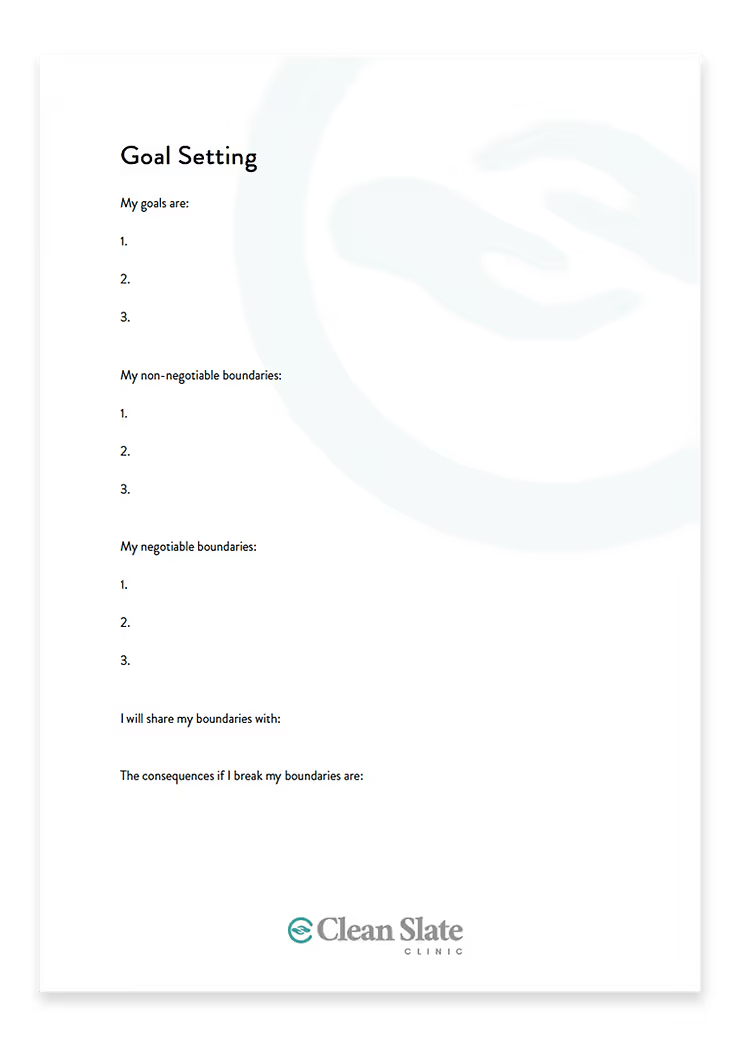
This document helps you to be clear on what your drinking goals are. It helps you set the boundaries you need to help you get to your goals. It works best if you can share them with a trusted person and have a self-imposed consequence should you break your own boundaries.
Download the PDF:
Clean Slate Clinic - Goal setting.pdf
Download the Word document:
Clean Slate Clinic - Goal setting.docx
Preview:

Past Lives: Surviving Suburban Perth
In the broad landscape of Australian culture, there's a thread we often pretend isn't there - through our suburban streets, cities, and country towns. It's the story of alcohol and substance dependence.
This series of stories; 'Past Lives', aims to pull at that thread. We're not here to sugarcoat or sensationalise. These are raw, unflinching accounts that lay bare the reality of a culture where getting 'pissed' is a rite of passage, where 'she'll be right' masks a multitude of behaviours.
But these stories serve as a reminder that while the road to recovery might be long and winding, it's far from impassable.
*Please note that this content discusses substances other than alcohol and comes with a trigger warning.

Portrait one: Dave
Google ‘World's most isolated city’ and Perth, Western Australia will inevitably pop up. From space, satellites will witness Perth's lights - a lonely beacon surrounded by darkness, with Jakarta as its closest capital neighbour, not Sydney - far across the Nullarbor plain.
For those vaguely familiar with Perth, you might picture the tree-lined streets of Cottesloe bumping up against the Indian Ocean where families eat salty fish and chips under the Norfolk Pines. Or the port city of Fremantle with its eclectic culture, Victorian architecture, and Rottnest Island a short ferry ride away.
But inland Perth lies a different world - the heartland of suburbia, where Dave Russell grew up in the 80s.

Lynwood. It's not a place that makes the tourist brochures. Today’s middle-aged Australians who grew up around here might recall brick veneer homes - with a Toyota Torana in the driveway and a Hills Hoist standing sentinel in backyard.
Dave says of the area; “It was borderline dodgy. We were sort of surrounded by some fairly hectic suburbs. We had Langford, and we had Thornlie, which became pretty rough. We had Gosnells. So growing up when you were a young fella, you had heard about the gangs that were going on, which was the skinheads and the rockers and they used to have some proper, proper barnies.”
In short, the backdrop was a suburb where separated parents, footy rituals and after-school fights, were as much a part of growing up as vegemite sandwiches. Physically, the landscape of these areas in the 80s and early 90s was quintessentially Western Australian (dry, treeless, modest homes). Thornlie and Gosnells did get the occasional crime headline fodder - and Willetton was also a neighbouring area and considered the "better side of the fence." Not that Dave was aware of any hierarchy.
“West Lynwood Primary School used to back onto Lynwood High School and there was only the copper logs that separated them in between. So for entertainment, all of us little tackers.. us nine-year-olds, ten-year-olds to tell you the truth, would sit on the copper logs, and you could pretty much guarantee, at least every second lunch break, there'd be a scrap on the oval, like a proper UFC style boxing match.
“I once saw a guy's ear get bitten off. He was getting belted since he was a little fella, and just when you thought his day was really going to be a mess, well it probably still was a mess because he ended up biting someone's ear off, but, yeah, he jumped up, grabbed these big guys by the side of the face, and just chomped about a third of the top of his ear off, and we were just in hysterics. We were just absolutely blown away, all of us little spectators.
“And I remember going back and telling my mum, and that was one of many stories, like, ‘Mum, Mum, Mum, I've seen an awesome scrap on the oval today. This guy got his ear bitten off.’ And mum would just sit there with this sort of pensive look taking it all in. And she's like, ‘Well, that's not really the right thing to do.’”

When high school loomed, Dave assumed he'd make the short hop to Lynwood High, but his Mum had other ideas. With a bit of address-swapping magic involving his Aunty, Dave found himself at Willetton - the more "academic and sports-focused" public high school.
“Because my Aunty lived in Willetton and we could do the dodgy, you know, fiddle the books and go to that catchment - I went off to Willetton Senior High School, which I enjoyed. It was good fun.”
In essence, it was a lucky escape, and Dave's overall experience was positive.
“We were bogans in the sense that we were absolutely loose, but we always had this undercurrent of sport. Willetton Senior High School had basketball scholarships. They used to get rugby teams together. I'm pretty sure we were the first public school in WA to start up a surfing class. Which to us, you know, we were like, ‘What can you possibly learn in a surfing class?’”
Dave doesn’t remember much of the ‘theory’ involved in the surfing lessons but he does recall being the only inland school that surfed in one of the comps against City Beach and Scarborough. Surprisingly, they came third.
“The fourth team didn't rock up, so we claimed bronze. By default.” Dave says.

Alcohol experimentation was par for the course in his teens. But it wasn't until the 1993 High School Ball that Dave had his first brush with harder drugs. They scored what he calls ‘old school truckies speed’ and Dave drank a bottle of Jim Beam and woke up in a paddock with a cow.
It was that whole ‘rite of passage’ School Ball thing - but it sowed the seeds for the next few years.
Post-school, Dave started a mechanics apprenticeship. It was during this time that drugs became more than just a one-off distraction.
“I was adventurous. I was just up for anything. I wasn't a big fan of needles, but I just went yeah ok. Let's do it. Nervous as shit, but we sat around my Dad's kitchen while he was away and, there was three of us. We were all really good mates and then James, he had to do it because we didn't have a clue what we were doing so he put the needle in, drew the blood back and then injected us with speed, and I can still remember that feeling.
"It felt like my head was a rocket and it was lifting off my shoulders, you know it was just like boom - your heart just took off like a racehorse. Your head lifted off. There was this huge wave of energy that just went straight through you. Your fingers tingled, your toes tingled. You felt like you could just go and run through a brick wall, you know.”
Science tells us that drugs hijack the brain's reward system, flooding it with dopamine and creating a false sense of what's important for survival. For Dave, it was speed that flicked this neurological switch.
“The next chance we got, which was honestly the next weekend or at least within two weeks, we did it again and then that became the norm.
“So Thursday, you got paid and you got on. And then Friday you felt like shit by the afternoon, so then you got on. And then Saturday, you know, the money's starting to get short, but we're all starting to help each other out. There was always a serious amount of IOUs going on and, yeah. It was an accountant's dream - trying to figure out the books of who owed what.”

Looking back now, Dave's reflections are tinged with a strange mix of emotions. There's no denial, no shock at his own story. It's just another tale of circumstance, of time and place. His recollections are coloured with bittersweet humour, a quiet happiness that he's no longer trapped in that life.
The end came abruptly, sparked by an ultimatum from a new girlfriend: her or the gear. It could have ended differently, but Dave found he had no trouble walking away from the habit.
“It was really definitive with that old-school speed. I don't feel like there was a huge physical dependency. It was more habit-breaking.”
Today, you'd never guess at Dave's past. On paper, he's the picture of a successful bloke - a nearly paid-off house in a lovely area a stone's throw from the beach, a wife of over 20 years, a couple of kids. He's travelled, lived abroad, and weathered the storms of grief and loss that life inevitably brings.
These experiences have shaped Dave into something rare these days - a true individual. In a world where our identities are often constructed by external expectations and societal pressures, Dave stands apart.
He's uninhibited, free from his past, neither reserved nor self-contained. He is happy to share his truth, chuckling as he does so, a living testament to the power of resilience and the unpredictable nature of what the cadence of life can bring.

7 Benefits of Home Detox
Van Gogh painted his famous Bedroom painting just after moving into the beloved “Yellow House”—the first place that he said truly felt like home - in Arles, France, in 1888.
It’s said that the composition was intended as “a restorative after a period of his depression”.
When you look closely at his ‘Bedroom’ artwork, it feels like a safe haven—particularly poignant for someone like Van Gogh. The artist battled alcohol dependence for much of his life, drinking wine and also heavier spirits such as absinthe—a drink reflected in his work, Café Table With Absinthe. And throughout his short and nomadic life, he had a relentless quest for the safety of home.
So, with Van Gogh’s work as a visual touchpoint, we want to crack open the question "How does the concept of 'home' contribute to effective health recovery and addiction treatment?".

The familiar setting of the home can significantly reduce the stress and anxiety often associated with the early stages of detoxification. Contrary to popular belief that recovery must be done in inpatient rehab, home withdrawal and recovery is recognised as an evidence-based treatment, and incorporated within national clinical guidelines.
Clean Slate’s home detox program offers a revolutionary approach to recovery, through delivery of complete home detox via virtual care, which allows individuals to begin their sobriety journey in a comfortable, familiar environment. The program has been independently evaluated by the University of Sydney as feasible, acceptable and highly adoptable.
The Clean Slate approach addresses not only the physical aspects of withdrawal but also considers the psychological and social factors contributing to substance dependence, and what needs to be in place for long-term success.
Below are seven ‘key benefits’ of our home detox program:
1. Personalised Accessibility:
The Clean Slate program is designed to integrate seamlessly into your life, allowing you to initiate your recovery journey at a time that aligns with your personal circumstances and readiness for change.
Unlike public rehabilitation programs that often have waiting lists of 3-6 months, or private programs that put you out of pocket by $20,000 or more, our home detox program allows you to start when you're motivated and ready without losing momentum.

2. Continuity of Care:
Throughout your 12-month journey at home, you are supported by the same dedicated nurse and doctor. This consistent, one-to-one relationship provides a strong level of trust and personalised care, and ensures that your progress is closely monitored and supported throughout the entire recovery process.
As previous clients have testified, working with the same nurses and doctors through the entirety of the program from home was what made it so worthwhile. One recovery patient wrote at the end of their 12 month program;“I want to thank Clean Slate for the exceptional, professional, and incredible care I have received! My detox was very well done, and I had enormous comfort & security knowing my nurse Lauren, who was AMAZING, was by my side the entire time! Dr Ian was brilliant, he valued, and cared, and validated me and my experience immediately! Thank you for empowering me to transform my life and health! I am eternally grateful!”
3. Enhanced Privacy and Discretion:
Being in a rehabilitation treatment centre can be an environment that is a vast complex of fear for many. Fear of being in the public eye, fear of the unknown, and fear that the distance from your real home comforts like pets, and familiar furnishings.
For those concerned about stigma or maintaining confidentiality, the Clean Slate home-detox program offers a discreet alternative to traditional rehabilitation centres.

4. Bridging the Gap for Remote Communities:
Small Australian country towns often have limited access to resources and many of Australia’s First Nation’s communities have to travel long distances to even see specialist doctors or nurses.
Having a science backed telehealth-based program is particularly beneficial for individuals in these regional and remote areas.
Whether you’re in the Goldfields or the bush, frequently travelling for work commitments, or simply in a region that doesn’t have support for patients wishing to undergo recovery, the at-home model brings professional care directly to you.
5. Cost-Effective Treatment Solution:
An at-home, telehealth model, allows a reduction of costs that might include travel and time off work as well as the price for treatment.
The Clean Slate comprehensive home detox program is priced under $3,800 for a full 12 months of support, putting it in the realm of affordability for most, as it is usually less than what people would otherwise spend on alcohol or other substances annually.

6. Access to a Supportive Online Community:
In addition to personalised care, we offer online group conversations up to five times a week that you can opt in or out of (but we encourage you to opt-in). These 'SMART Recovery' support sessions, facilitated by our trained team, cover various topics relevant to recovery and provide a peer group community throughout the 12-month journey, with the option to join these sessions fully anonymously.
This allows those in the program to have a blend of individual care and group support, which can help to create a solid framework for making positive change.
7. Comfort and Psychological Safety:
CEO of SMART Recovery Australia, April Long, said of home-detox; “One of the most significant advantages is the comfort and emotional support it provides. Detoxification is a monumental step for most people, and being able to go through it in a familiar environment surrounded by their own comforts and support systems can make a world of difference.”
One of the main reasons clients will choose the home detox option, is because they feel most secure in their own surroundings. The Clean Slate program leverages this comfort, allowing you to begin your recovery journey in an environment where you feel safe and at ease.
It's crucial to note that attempting to go "cold turkey" without proper medical oversight can lead to acute withdrawal symptoms, including insomnia, increased tremors, poor concentration, low mood, nausea, and intense cravings for alcohol, which can potentially lead to relapse.
Approximately 85% of individuals with alcohol dependence will be suitable for home detox, but for some individuals with severe alcohol dependence, inpatient withdrawal may be necessary.
Our team of medical professionals will assess your individual situation and recommend the most appropriate level of care to ensure your safety and maximise your chances of successful recovery.
Clean Slate Clinic is accredited by ASES, and regulated by AHPRA (Australian Health Practitioner Regulation Agency).
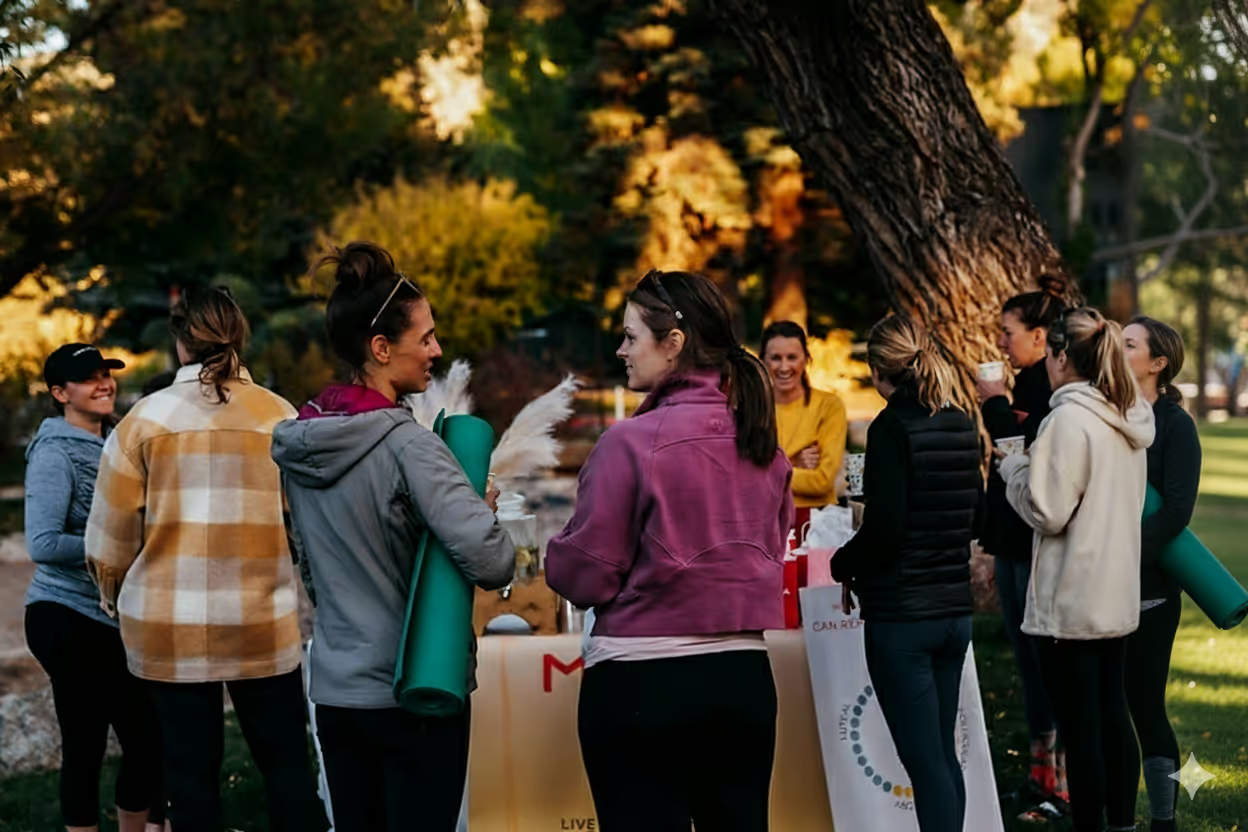
Women's Health Week
“Your Voice. Your Choice”
With this year’s Women’s Health Week theme ‘Your Voice, Your Choice’ - we spoke to Corporate Wellness Speaker and podcast host of ‘Not Drinking Today’, Isabella Ferguson and The Alcohol Mindset Coach Kathryn Elliott, to turn our attention to what often evades our awareness - our health, and address women’s relationship with alcohol today.


Two words. ‘Voice’ and ‘Choice’. Sometimes having words to reflect on can help to guide our decisions to forge a healthy path forward.
When it comes to ‘Our Voice’, across Australia and the world, women today are breaking through the cultural reticence and finding their voice. The voice also highlights the significance of listening to stories told. It’s so important sitting with other people’s words, including those with lived experience and allowing those voices to speak their truth without judgement.
‘Our Choice’ can mean facing fears and breaking through cultural barriers. It’s empowering to feel in control of our choices, particularly when it comes to healthy decisions around alcohol.
Facing Fears
Something that often stands in the way of women speaking up, or making healthy choices for themselves - is fear. Fear of being judged or shamed. For those who battle with alcohol and substance dependence, fear can embed itself in our inner voice, running riot in our minds and echoing ceaselessly. A hangover can make the inner voice intolerable with next-day cringes over things we did or said the night before.
Many women hesitate to admit—even privately—that they might have a dependence on alcohol. This reluctance makes it all the more admirable when someone finds the capacity for honesty - to acknowledge their struggle and take those crucial first steps toward seeking help.
‘Not Drinking Today’ podcast co-host and recovered lawyer, Isabella Ferguson, confronted her fears after what she admitted to “being stuck in a stress-drinking-burnout cycle”, and drinking to cope with work, parenting, and a growing dissatisfaction with how she was living.
“I was a litigation lawyer, a step-mum to two girls and mum to two young boys and drinking to get energy, to relax, to get to sleep, and to socialise. I was a functional drinker for years until I went to a treatment centre for support. For the very first time I had the space to objectively view my life and see that it was heading for a train wreck.”
As a lawyer and parent, Isabella straddled the complexities many working mothers face - the limitations of being in tune with your own identity as life accrues more and more responsibility to others, and leaves less time for yourself.
After treatment, Isabella now says that she approaches alcohol mindfully rather than habitually, and sees it as something that overall, only attracts negative impacts. Reflecting on the demands of women, she says; “Most women are time-poor and are spinning 101 plates in the air with competing demands vying for their attention. A glass or two of wine replaces a run or a walk with a mate. At the start, it’s an attractive quick fix. In reality though, drinking perpetuates an unhealthy cycle. As our tolerance grows, the more we drink, the more fatigued, stressed, unhappy and unhealthy we become.”
Today, Isabella uses her voice by acknowledging alcohol, stress and burnout.
“For me, my voice has been a crucial component of breaking my alcohol dependence. Starting a podcast about alcohol, sharing my story, and supporting others in my counselling practice have helped me to stop relying on alcohol. It has allowed me to feel purposeful, seen, heard and not alone in my pursuit to drink less.”

Reshaping Culture
Growing up as a teenager in the 80s, Alcohol Mindset Coach Kathryn Elliott, experienced regular binge drinking. In fact, most Australians who grew up in this era will recognise drinking alcohol with their mates on weekends as familiar terrain. It was accepted as a rite of passage, and now—those in their 40s and 50s are seeking to break these deeply ingrained habits.
Kathryn says that shifting these long-formed drinking habits can take up to 12 months for women in their 40s and 50s, and the change involves focusing on neuroplasticity - and rewiring the brain - which requires time and repetition. Kathryn believes that if people can find a meaningful reason to reprogram their neural pathways, that will allow new responses around drinking to form.
Kathryn's last drink was on June 30, 2019, and she admits it took about a year to completely change her perspective on alcohol. Shortly after, she was diagnosed with breast cancer, which only made her more determined to stay sober.
Kathryn openly addresses the science linking alcohol to breast cancer and today uses her voice to raise awareness about the indisputable evidence-based research connecting the two. If you’re a woman seeking facts about the carcinogenic impacts of alcohol on the body, Kathryn has a staggering scope of stats that she is more than eager to share.
She says; “Women are affected by alcohol differently to men. We have less of the enzyme alcohol dehydroganese, called alcohol D, that breaks down alcohol, which means we absorb about 30% more alcohol into the bloodstream than a man of around the same weight.”
“We also have more body fat. Men have a higher water percentage, so they're able to dilute the alcohol in their bodies. And then women who go through hormonal changes like perimenopause, will also notice exacerbated symptoms and less alcohol tolerance.”
Kathryn is proud to use her voice on women’s health in her coaching work and as an advocate for those who are living with breast cancer or struggling with alcohol.
“I stopped drinking at the age of 46 and I'm about to turn 52 later this month. What I will say is that choosing an alcohol-free lifestyle for me has been so incredibly freeing. And it was something that I didn't believe was possible for me in my 40’s.”

The Company We Seek
Women seek belonging and connection and their lives are often characterised by conversations with family, friendships, and other relationships, which are all integral parts of our health and wellness.
In the same vein, sometimes the greatest liberation is not having to be in the company of other people dependent on substances. Often, you realise your personalities don't truly align. You're merely there for the social connection that alcohol facilitates.
Kathryn says; “I think my friendships with people since I've stopped drinking have become a lot more connected. With my friends who are drinkers, it took some time to realign and work out where our friendships were at - but I've managed to feel really comfortable now with those relationships. Yes, they've changed, but there's acceptance and no judgement either.”

Embrace Change
Embracing change for both Isabella and Kathryn has proven to alter their lives for the better and using their voices has empowered others. Both women are passionate about the science behind alcohol and are also extremely empathetic, with an insistence that each of us is worth more than the worst thing we’ve done.
Kathryn has just returned from delivering a presentation at the Melbourne Exhibition Centre for Women’s Health Week when we speak and I ask her how she is feeling these days.
“Well it’s five years since diagnosis and yeah, I'm doing really well. My health is really good, which is fantastic.”
Where Kathryn is today has not been an easy journey but a worthwhile one. She says that “..it has come through a lived experience of going through both breast cancer and binge drinking and publicly talking about it.” and admits - that’s hard to do.
For those thinking about change, Isabella suggests; ”Start by taking a bird’s eye view of your weekly routine and ask yourself some questions that bring awareness to your situation for changes to be made.”
She recommends women take a few moments to turn the lens on themselves and ask:
- Does my alcohol consumption have a role in how unhealthy and unhappy I am feeling?
- Am I using alcohol to cope with stress?
- Is drinking harming me more than helping me?
- What do I actually need and want?
- Can I swap drinking with another way of de-stressing, such as exercise?
Knowing that the answers are both common and impermanent may help in your journey forward.

History demonstrates that when we make thoughtful choices, speak up, and raise our voices, change occurs gradually. Women are elected into government, outdated patterns and belief systems change, habits of life can get smaller and shrink - and become a point of history in your own story.
This week, commit to healthier choices, embrace your authentic self, and find the courage to raise your voice. This is where true empowerment begins, where we can transform our lives and inspire others to do the same.
- Follow more info here: https://www.jeanhailes.org.au/womens-health-week
- Clean Slate Clinic Podcast with Isabella here: https://www.cleanslateclinic.com/not-drinking-alcohol-today
- Kathryn’s Alcohol Mindset Coaching website here: https://www.thealcoholmindsetcoach.com/
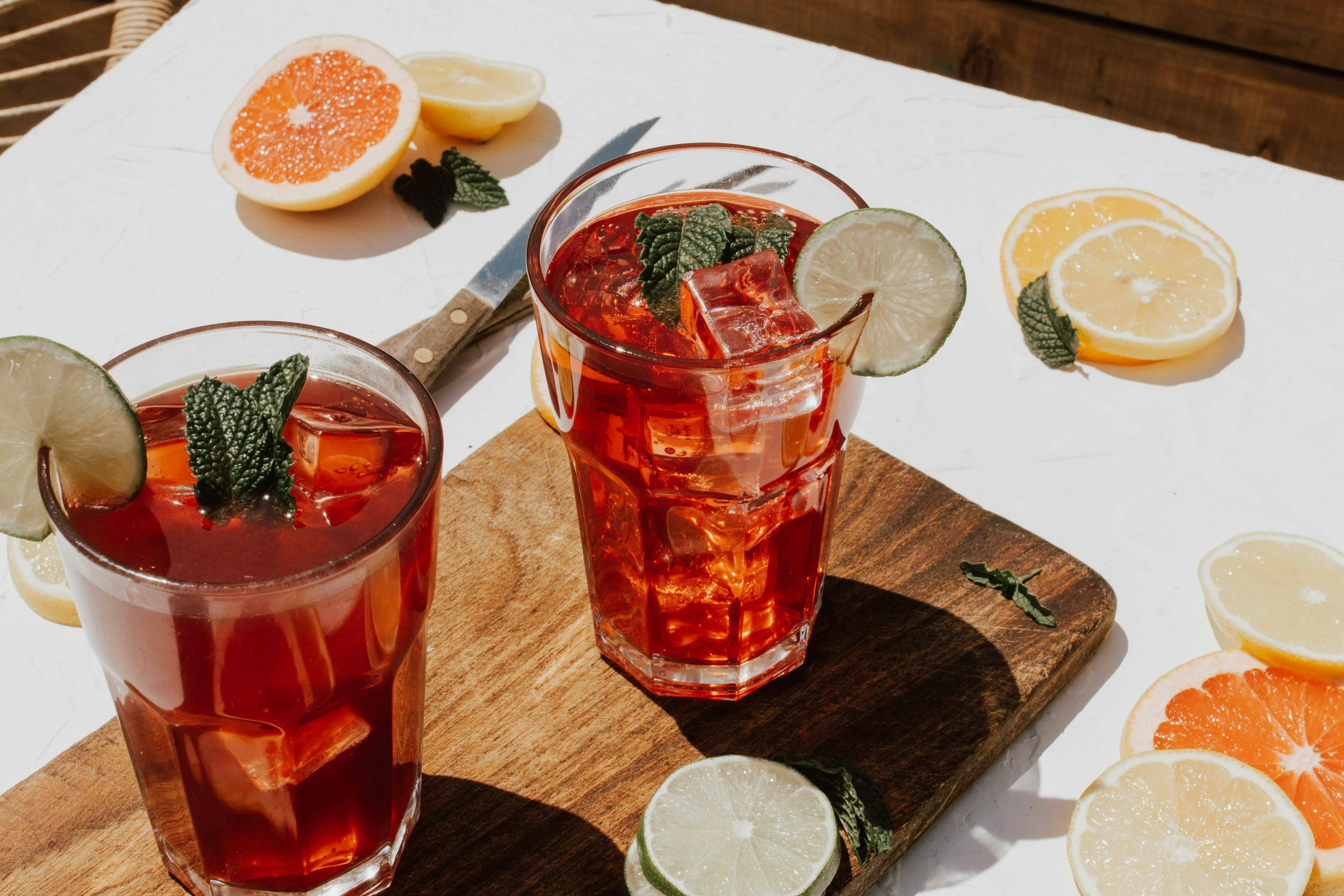
After Detox: Could 'zero alcohol' help?
This webinar delves into the potential benefits and considerations of incorporating alcohol-free options into a client's recovery journey, featuring expert insights from Dr. Ian Guinan and personal experiences from Chris Gimpel, offering a comprehensive look at life after detox and the role of zero-alcohol products.
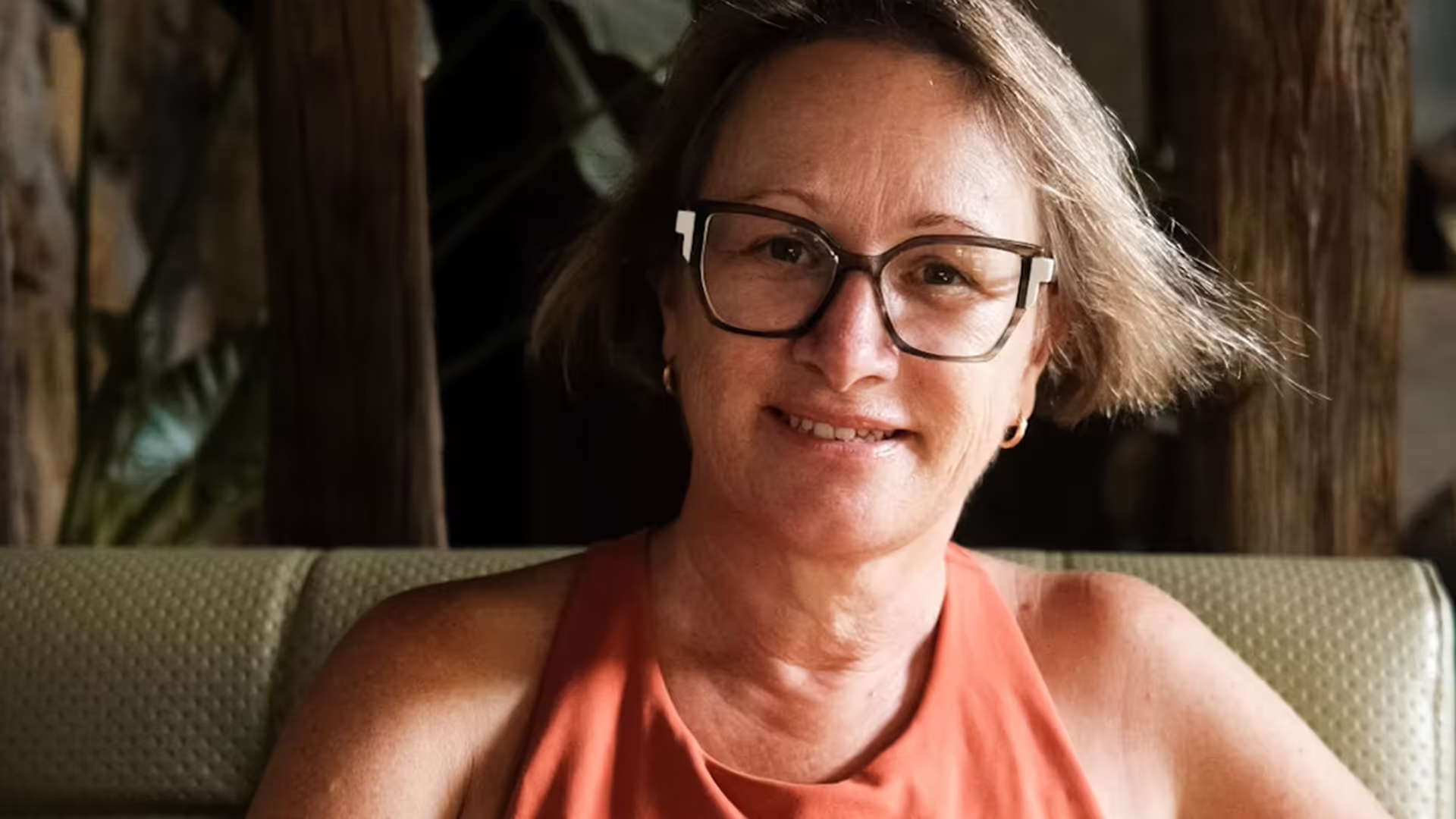
A Chapter of a Journey.
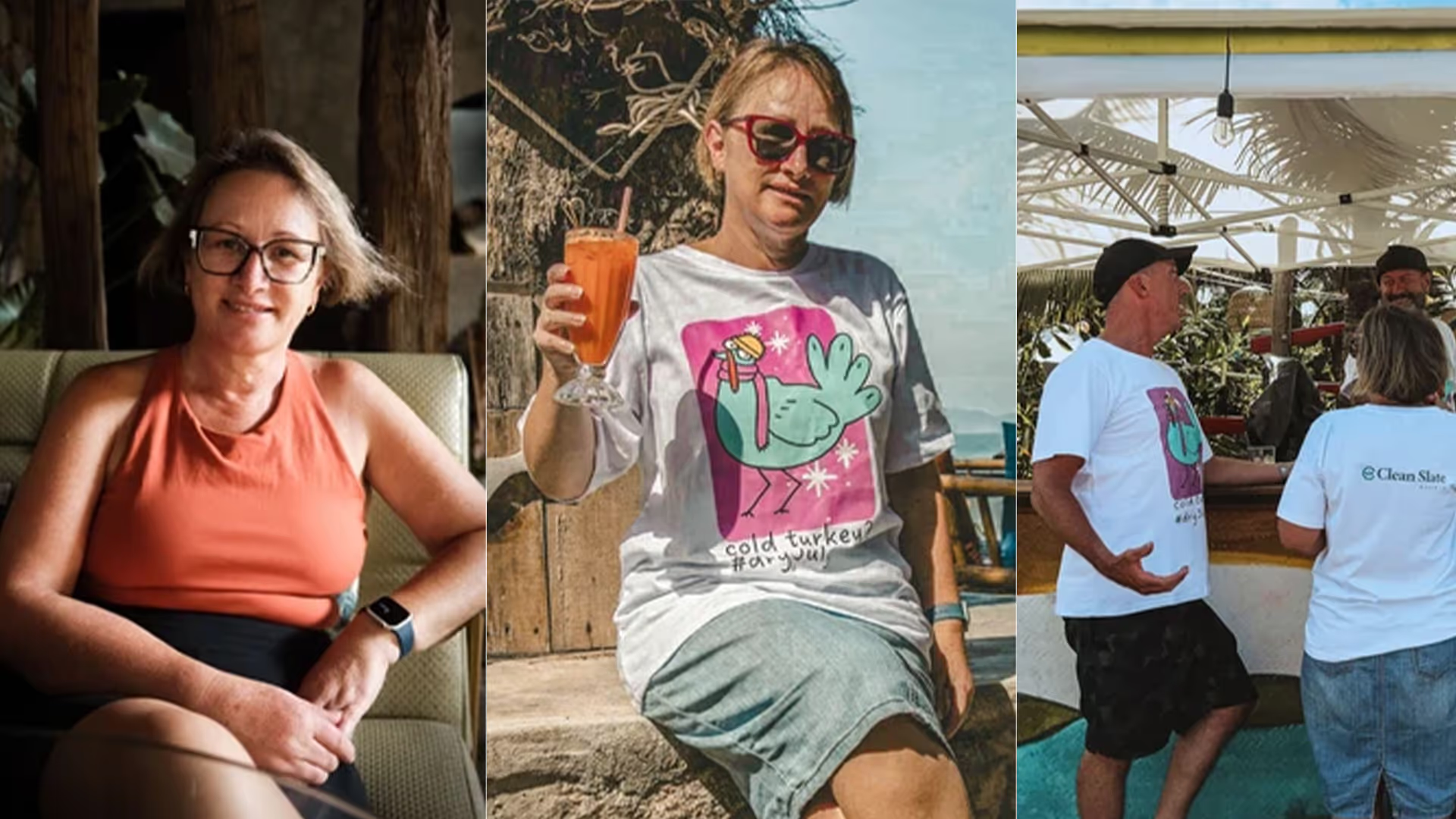
I recorded Louise’s story in a bar. The icebreaker into the conversation started when Louise ordered her mocktail. She couldn’t recall if it was called ‘no sex on the beach’ or just ‘safe on the beach’ (it was the latter).
Louise is a mum first. With two adult children, aged 25 and 20, she is openly proud of their maturity and achievements. Professionally, she has functioned well as a successful accountant and business advisor, a role that requires significant mental acuity. But alongside her indelible nature, love for people and strength in her business, Louise admits to having consumed alcohol in excess.
She’s unfiltered, and didn’t hesitate to admit that she had been addicted to alcohol and that she’d weighed up to 90kg not so long ago. Photos of her former self look like a relative - not the wispy fair-haired, petite-faced woman in active wear sitting before me.
Louise had a couple of rough years where her mother and stepmother passed away in close succession and for a long time, used alcohol as a crutch, justifying the habit by telling herself that she worked hard and deserved it, as she didn’t engage in other vices - had no other substance abuse issues, and was a working professional.
“I would sit in front of the television every night basically and just drink a bottle or a bottle and a half of wine just because I could, and I would justify that to myself by telling myself that I worked hard and I was a good person and I didn't do drugs or any other things so this was my thing that I did and that it was okay.”
Louise took a short trip to Vietnam - mostly with the intention to lose weight and live more healthily. She said if she had to get food or alcohol, she’d have to ride or walk. Her decision to travel was a simple intuition swept along by dogged determination to make change. And around the somewhat impulsive call for action, came corrective serendipities that nudged her, this way and that, along a healthier course of life.
In May, Louise turned 50 and celebrated with a milestone birthday party - which was accompanied by the usual collection of beers, wines and spirits. The celebration inevitably led to further weeks of overindulging in alcohol, and by June - she called a 28-day ‘cold turkey’ challenge, and up until now, she’s gone on to remain booze-free.
“I did it with someone else. We said that we'd do a four-week detox. They didn't, they sort of took a little bit of a different turn partway through, which is where they're at. That's fine. But I realised after about a week and a half in what it was about. It wasn't just about the health benefits. It was more the long term and just taking back control and that I was in control of what I was doing.”
This ‘taking back control’ is something that is so liberating about sobriety. You are forced to live life on life’s terms, without the insulating effects of alcohol or drugs. By being sober, Louise learned her true and complex relationship to the world. She also found, to her surprise, that happiness is possible as life broadens into something intricate and deeply fulfilling.
Louise acknowledges the cultural challenges of sobriety in Australia, where alcohol is well and truly embedded in social activities.
“It's hard in Australia because it doesn't matter what we do, whether we win the game, lose the game, you know, babies, weddings, funerals, everything, we celebrate and mourn with alcohol.”
“It's absolutely everywhere. We go camping with alcohol, we go fishing with alcohol, we go have a dinner. It’s just such a huge part of our culture.”
Despite this, she found that people were supportive and genuinely curious about her journey. Their encouragement, rather than judgment, provided additional motivation.
“Everyone was really good. They were like, ‘Oh, I wish I could do that’. People did ask me (about not drinking). But they genuinely wanted to know why.” ‘Was it for a health thing? Was it for a bet?’ They're just curious. And I think it's genuine curiosity. I don't think it's judgement or calling you out. I think it's like, ‘Oh, I wonder if she might say something that might, inspire me.’ which is important, especially when you're in a community where people do have that, that dependence and that habit of alcohol.”
We all have a story. We all have chapters. They make up our lives and our big biography. What matters is that if some chapters aren’t so great, then we learn from those and make improvements for the next ones. We become wiser - and maybe no-one will notice - but importantly, when you are sober, you will notice.
The chapter that Louise shared evokes a little grief of loss and trauma, but mostly, offers hope. And for those who feel they might have the capacity to change, her words inspire actionable encouragement towards re-evaluation and growth.
Louise is still in recovery. These are early stages. But it’s a really important junction point for many people to be inspired by. Too far along - sometimes it can feel preachy or too far from achievement. Louise is happy with her day-to-day achievements. Sometimes it’s easier to hear from people in recovery not out of it - to motivate you.
She’s been doing art classes, taken singing lessons (but with a laugh admits that was not a strength of hers), and just completed her diving certificate. She advocates for doing what we love with our time and rewarding ourselves with healthy activities rather than harmful ones.
We are all full of worry until we begin the task, but Louise shows that in the end, things tend to find their way if you trust your intuition.
After our chat, Louise is off to deliver flyers for her gym’s circuit instructor - putting them in cafes and hair salons. Places where people might be encouraged to join.
I passed Louise later that evening while walking past the local pub. There she was with her mineral water, sitting with the raucous group of regulars - and to my surprise, another bloke had joined her - also with a mineral water in hand. Unintentionally, it was catching on.
Listen to Louise and her story.

Breaking it Down: Alcohol & the Brain
Ever wondered why a glass of wine might help some to unwind, or why it can be hard for others to stop at just one drink?
Understanding alcohol’s impact on mind and body could help you to assess and, if necessary, modify your drinking habits.
Why does it feel that way?
The short answer is that alcohol triggers the brain’s reward system, which can help people feel more relaxed or sociable. That’s why it can be such an effective quick fix for those struggling to achieve either (or both) states.
Unfortunately, alcohol also changes how the brain handles stress and anxiety. Which is why some of us experience that dreaded morning-after nervousness (you might know it as 'hangxiety') - and over time, alcohol actually makes our stress worse.
The more you drink to relax, the more your brain struggles to regulate stress on its own, leading to more serious changes in the brain over time - including reduced sensitivity to GABA (a calming neurotransmitter) and increased cortisol production. This means that when you're not drinking, you’re more likely to feel anxious, overwhelmed, or even low on energy.
The science bit
When alcohol enters the system, it affects four key brain chemicals (known as DOSE) – dopamine, oxytocin, serotonin and endorphins.
Here’s how they can change the way you feel, and behave:
Dopamine
Dopamine acts like your brain’s cheerleader. Commonly known as the 'reward' neurotransmitter, it appears naturally when we accomplish something meaningful – like winning a race or reaching a goal. It signals pleasure, energy and confidence.
Alcohol hijacks this reward system, delivering those feel-good sensations without any actual achievement. Unsurprisingly, this can leave you wanting more and more alcohol to keep your dopamine levels up.
Oxytocin
Oxytocin is like your inner social butterfly – it makes you feel warm and fuzzy around others. When it’s boosted by alcohol, everyone at the party may feel like your best friend. That’s why someone might find themselves sharing their life story with strangers or sending an ill-advised "I love you" text to an ex – shudder.
Serotonin
Serotonin is the brain’s mood regulator, influencing happiness, appetite, and sleep patterns. While alcohol can temporarily boost serotonin levels, the rebound effects may include low mood and sleep disruption.
Natural ways to boost serotonin (that don’t lead to ‘hangxiety’) include physical movement, spending time in sunlight, a balanced diet and engaging in activities you enjoy.
Endorphins
Endorphins are the natural painkillers and mood elevators produced by the body. The artificial stimulation of endorphins from alcohol can lead some people to develop dependence, as the brain begins to rely on drinking rather than natural sources of endorphins.
Pausing for thought
Anyone reconsidering their drinking habits should take time to consider why they drink, says Dr Chris Davis - addiction specialist, GP and co-founder of Clean Slate Clinic.
Is it to self-medicate? To relieve stress? To conform to social norms? Or to enhance the experience at events like parties? Whatever it is, this knowledge is the key to identifying and managing triggering situations.
Keen to cut down, or stop entirely?
Rather than just removing alcohol, Dr Chris recommends leaning into existing strengths, such as family support, physical activity or creative hobbies. Something familiar and accessible may be an ideal starting point for positive change.
Next, start exploring new activities – things you genuinely enjoy without drinking. You’re looking for natural sources of those DOSE chemicals! Here’s some more helpful tips:
Build a support network
Surround yourself with people who champion your healthy choices. This may involve gradually distancing yourself from those who promote drinking, while cultivating friendships with non-drinkers in your social circle.
Share your goals
Being open about your intention to cut back or stop drinking alcohol may help you be more accountable, which can provide the motivation needed to stay on track. Consider sharing your goals with trusted friends or family members who can offer encouragement and support. Online communities of people on similar journeys can help with this too.
Set clear limits
Go into social drinking situations with a plan. This may involve counting your drinks carefully, alternating between alcoholic and non-alcoholic drinks and/or choosing low-alcohol options or mocktails.
Volunteer your services
Put your hand up to be the designated driver. It’s a practical way to limit drinking and it saves you money (on drinks and taxis). You’ll also help keep everyone else safe.
Be kind to yourself
Understand that it can take 6-12 months to rewire ingrained drinking habits in the brain. During the inevitable highs and lows, try to treat yourself with the same empathy you’d have for a loved one.

Reach out (if you could use some help)
Please know you don’t have to do it alone. If professional help is the way to go, you could check in with your GP, or complete our suitability test in the privacy of your own home.
Whatever you decide, being honest about your struggles and taking actions to address them are crucial, courageous first steps. That alone is something to be proud of.

The Pursuit of Progress Over Perfection
In moments of self-reflection during recovery, we can confront an uncomfortable truth - that the journey is rarely linear.
The path towards change — whether breaking free from alcohol or overcoming other substance dependence - demands we embrace an essential paradox; that true healing often emerges from our perceived setbacks.

As Dr. Chris Davis (Clean Slate co-founder, GP and AOD specialist) will tell you, "Recovery isn't about never falling; it's about learning to get up each time with an improved understanding of ‘why’ we fell in the first place."
Consider a marathon runner. They don't sprint from start to finish but rather find their rhythm, adjust their pace, and sometimes, slow down to ensure they complete the distance. Similarly, meaningful personal change is not about racing to perfection but about sustainable progress.
"Sustainable growth towards change comes from building consistent, manageable habits rather than attempting dramatic overnight changes." Dr Chris says.
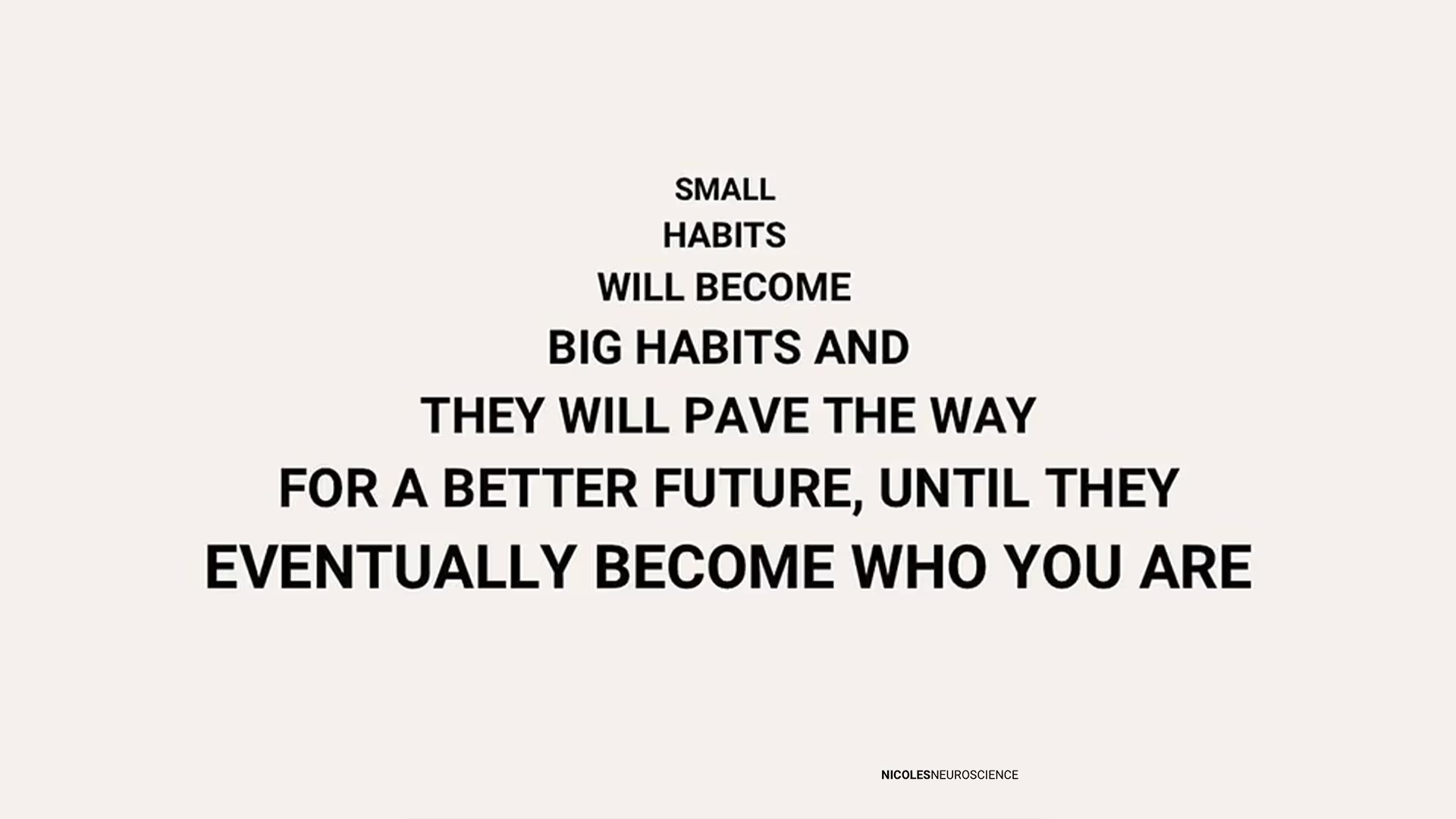
So how should we respond if we relapse? Rather than surrendering to self-judgment, we can choose to approach these moments with curiosity.
Ask what circumstances surrounded the slip up? What internal narrative were we telling ourselves? Was it confidence we craved? A temporary escape from anxiety? Often, stress emerges as a primary trigger for substance use, pushing us toward familiar but harmful coping mechanisms.
By identifying these underlying triggers, we can begin to map the whole landscape of our dependence and work out the best path to recovery.
Instead of ruminating in regret, we can use these junction points to create practical strategies for maintaining a healthy relationship with alcohol. This might mean identifying when to reach out to your support network, attending additional SMART recovery meetings, or ensuring you have healthy coping tools readily available.
Chris Gimpel, who leads our SMART recovery groups as Head of Client Engagement at Clean Slate, sees these concerns come up regularly in group discussions. Having navigated his own journey with alcohol dependence, Chris understands deeply how setbacks can impact someone's confidence and mental wellbeing.
He shares, "You know what? These questions come up in almost every session - you're definitely not alone in this. What I've learned, both personally and from our group members, is that reaching out after a lapse is one of the bravest things you can do. Just having that conversation, whether it's with a support person or even in the SMART Recovery group, can give you that spark to keep going. That's where the real strength is - in being open about it and letting others support you. After any slip up - you actually have completed an experiment and now have all the data you need to choose the next steps"
Ultimately, progress isn't about achieving perfection - it's about developing a deeper understanding of ourselves and building a toolkit that works for our own individual circumstances.
Each step forward—and yes, even each step back—contributes to this growth mindset. Seen through this perspective, these moments don’t become a point of failure, but opportunities for deeper learning and stronger resolve.
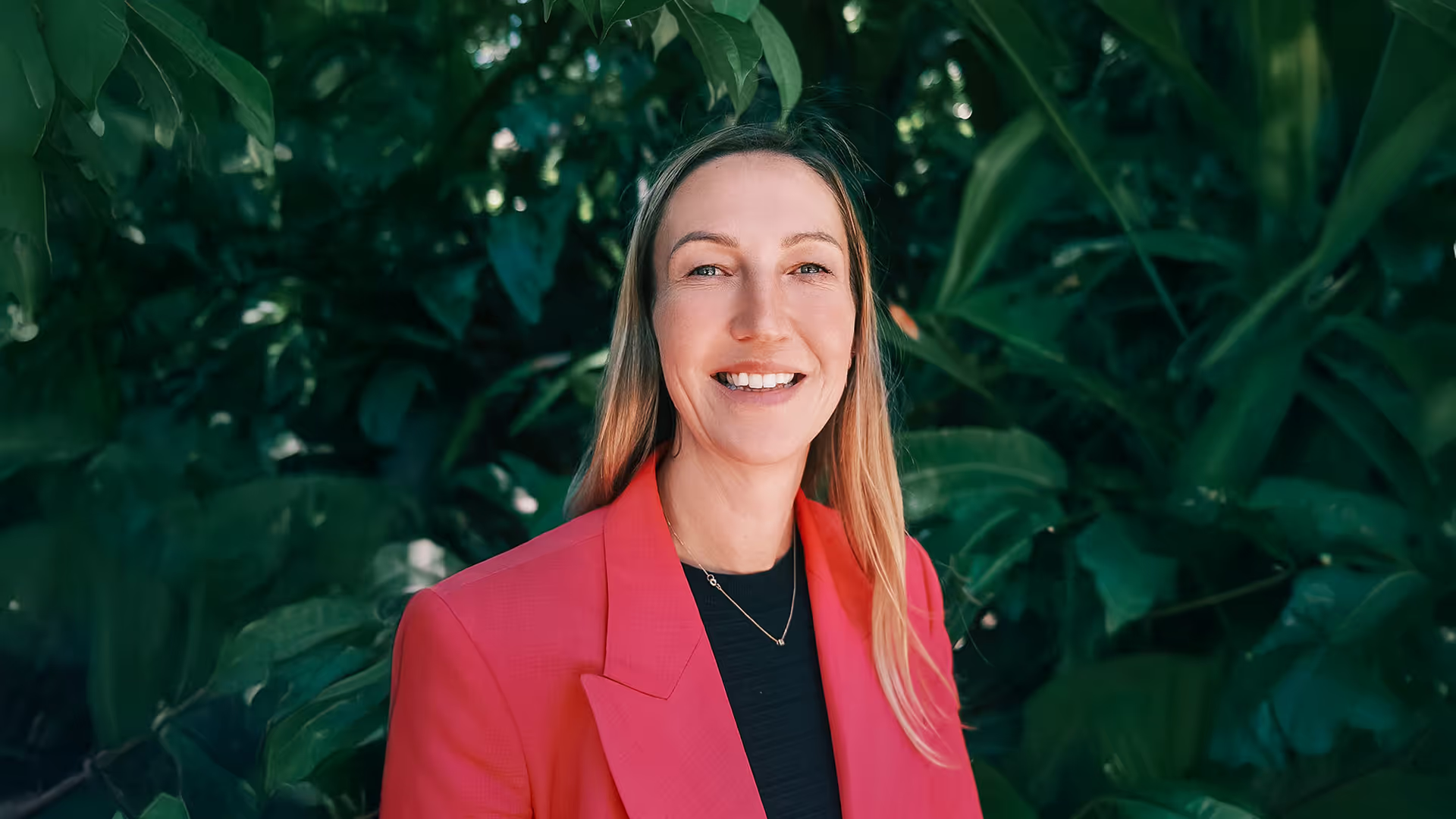
Spotlight On - Pia Clinton Tarestad
Like many of our clients, CEO of Clean Slate Clinic, Pia Clinton Tarestad's journey to recovery began with an uncertain Google search.
"I remember sitting there, typing 'Am I an alcoholic?' into the search bar. It was the only term I knew, the only language I had to describe what I was experiencing."*
Pia’s personal story is imbued with inspiration, and when it comes to this truth-telling, Pia herself is uninhibited. But although the barriers are down when speaking of her journey, she’s also the first to point out her privilege in the circumstance.
“When I recognised that I had a problem with alcohol, I was probably sitting in the most privileged position that you can be. Very good job, very high health literacy - I had been working in healthcare for 20 years plus. Even still, I didn't know where to turn for help.
“I was incredibly ashamed. I had an image in my own mind of what an ‘alcoholic’ was, and that's a term, that's the only term that I knew.
“There is a shame, a fear of being labelled. And it stops people from reaching out.”
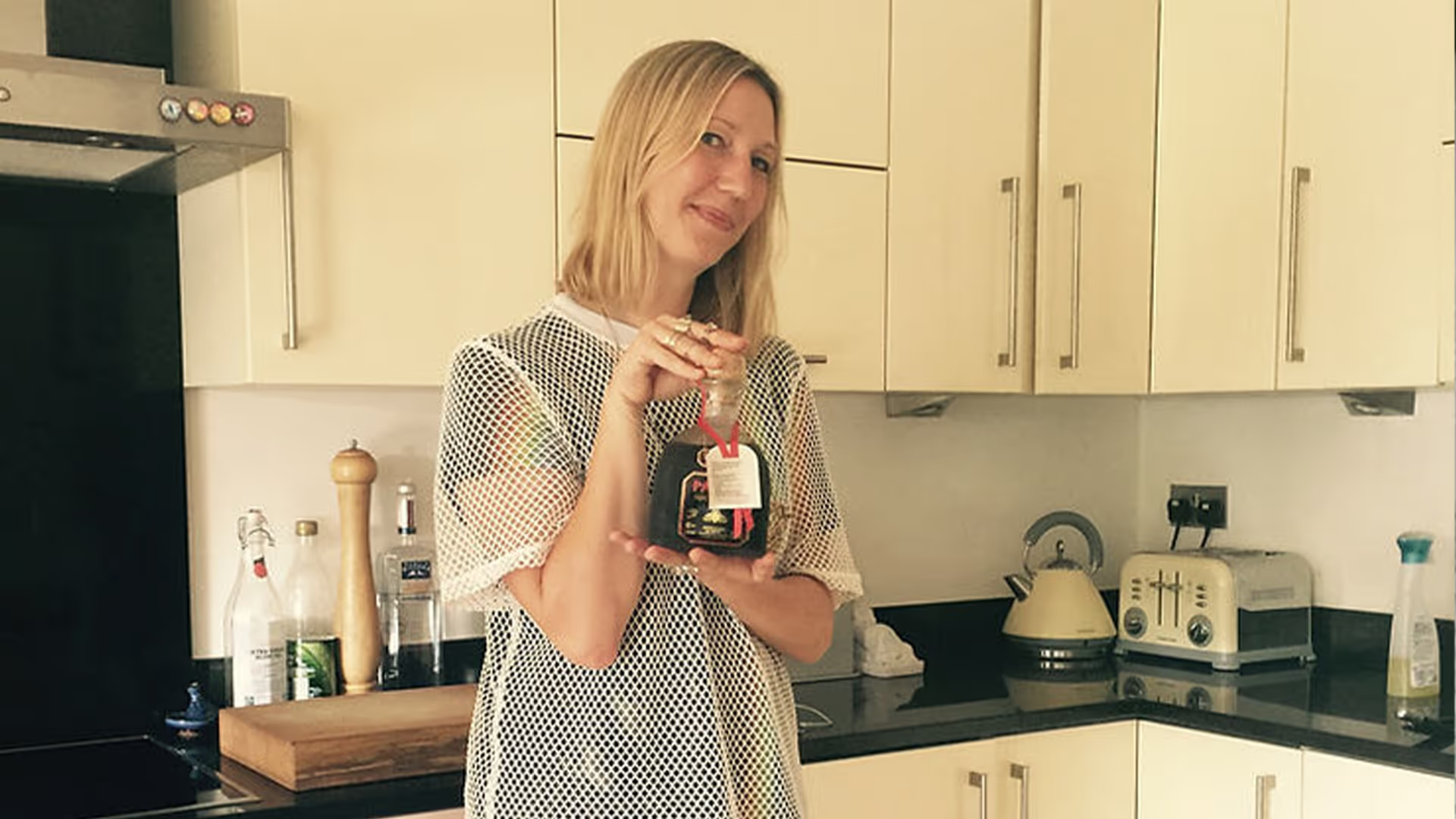
Today, having worked through this part of her life journey, Pia is now a titan of activism and advocacy for people with substance dependence.
Speaking to her, you get a sense of this determined and driven self. The one with the Masters in Healthcare and with an impressive professional profile working in the public and private sectors as the Head of Specialised Commissioning in the NHS, and as a Partner in healthcare strategy at Deloitte. You sense that she is a woman with a strong work ethic who genuinely wants to get the job done well.
Of course there is also the Pia who recalls having her first sip of alcohol and a cigarette at maybe 11 or 12 in her hometown in Guernsey - an isolated but beautiful island in the British Isles that few people have heard of. The Pia who, in order to get ‘beer money,’ went out and got her first job as a secretary on a vascular ward in London. And the Pia who found alcohol became an entitled perk in the corporate world, where a ‘networking’ culture would serve as a euphemism for drinking.
These different sides of Pia are not at odds though - they are simply facets of being a human. Like all of us, she contains multitudes: determined yet vulnerable, driven yet honest. She has been through the paces of life experience and has had her world shaken up like a snow globe, but ultimately - has set her compass back on course and found a true path without dependence on alcohol.
When Pia started Clean Slate (or as she labels her role - an ‘accidental’ founder and ‘reluctant’ CEO), it was driven by both her personal interest, with her unresolved issues with alcohol and her professional passion for healthcare equity. As it turned out, Pia was patient zero when testing the program, and successfully completed the 12 month trial including the medicated detox and aftercare - which gave her the confidence to really want to push the service.
“We did friends and family testing where the idea was we were going to take 10 friends and family through the process just so they could experience the telehealth consultation with the nurse.
“And I was the one of those that actually met the criteria to go through the service, which wasn't a huge surprise to me, but it was a bit of a shock to Chris, I would say.
“I did my detox, went through the aftercare part of the program, and came out the other side. So I knew what we had was something kind of special.”
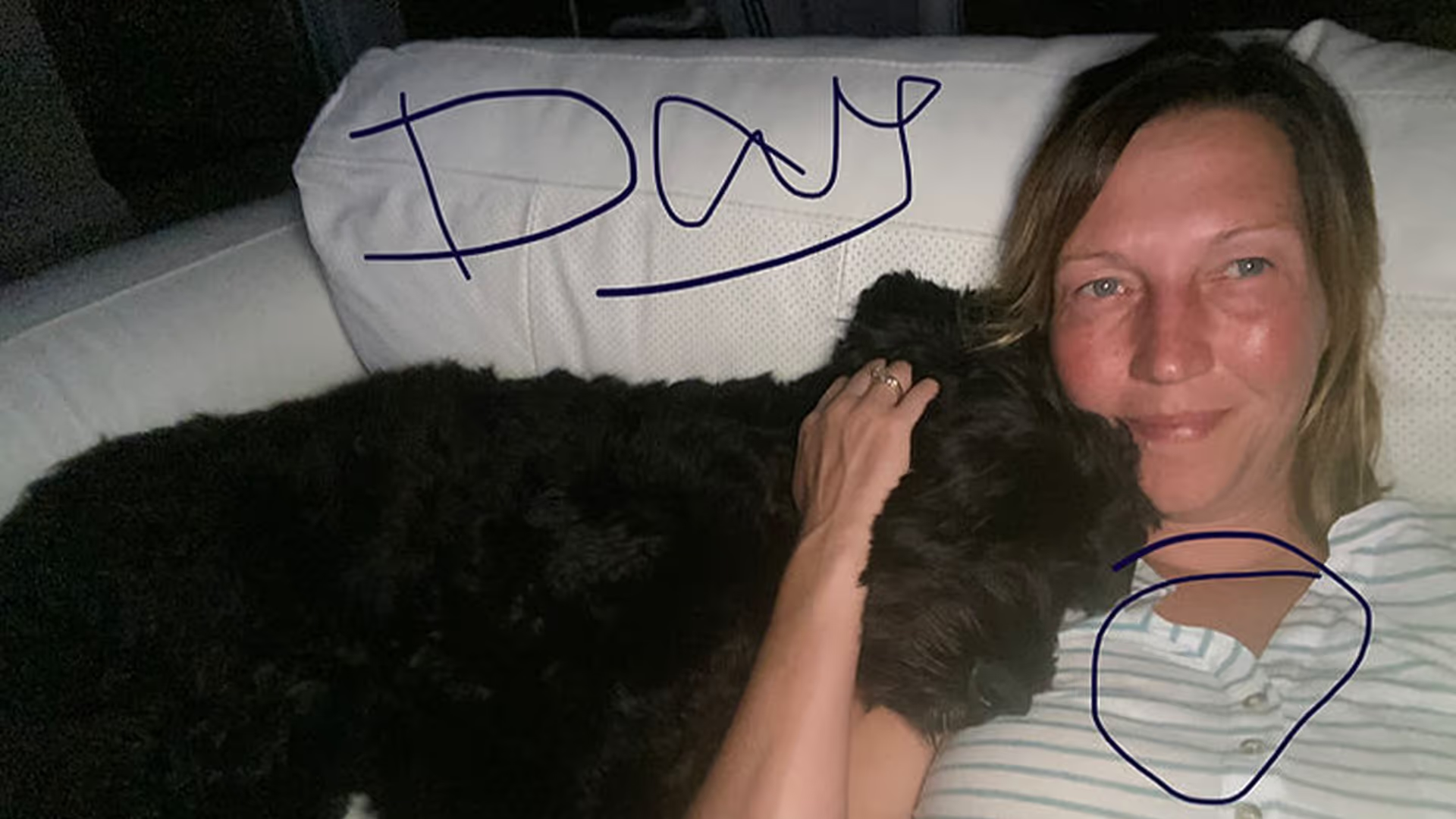
Today, Pia is viscerally determined to make a difference to the lives of others. There is a genuine desire to leave the world better than she found it. She’s now one of over 1000 clients who have gone through the Clean Slate service which is a testament to the sustained growth of the organisation. This year, Clean Slate was one of 18 mission-driven ventures to receive funding from the Harvard Innovation Labs Social Impact Fellowship Fund. On top of this, several insurance partners now offer the service free to their members, and plans are in place to scale to the UK this year.
But what drives Pia isn't the numbers or accolades - it's the understanding that everyone deserves access to compassionate, effective care.
“We set up as a social enterprise which has a social justice heart and that’s really important to me.
“We’ve done an amazing job in reducing stigma. We’ve done an amazing job at reducing geographical barriers to access, and financial barriers to access. And we are supporting some women’s shelters to support women fleeing domestic violence
“We’ve also done incredible work with Aboriginal and Torres Strait Islander community partners to make our service more accessible in terms of making it culturally safe. But actually to have the funding to provide the service for free to those communities - we’re not there yet.
“We have small pockets across the country, but I have a burning ambition and fire in my belly to get more funding.”
This fire in her belly is certainly evident, and it radiates through the Clean Slate internal operations team of doctors and nurses, where all staff members share not only a deep sense of purpose in helping others, but also nurture a strong workplace culture and sense of community.
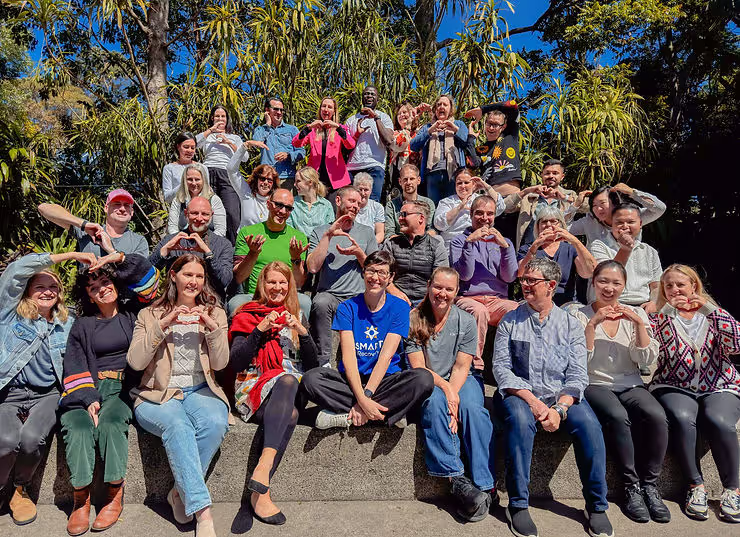
After a recent team professional development weekend in Melbourne, Pia teared up and said; “To see 40 people in the room who only had great things to say about the organisation was a really humbling and really proud moment.
“We’ve been really focussed on the impact on communities, but to see the impact on the team - and that everybody feels motivated and connected to the purpose - I’m just so proud that we’ve managed to create that.”
From Pia’s first tentative Google search seeking to understand her own alcohol dependence, to becoming CEO of Clean Slate Clinic, her journey demonstrates the power of change. Not only has she rewritten her own story, but she's built a platform that empowers others to reclaim their lives through accessible, dignified recovery care. And as Pia says; “I’m committed to both equity and quality. And am determined to make underserved communities receive access to our service. We can do more and we will”.
*For the record, a better Google search might be ‘Do I have alcohol dependence?’ or ‘Do I have alcohol use disorder?’ - And yes, ‘alcohol use disorder’ is recognised as a chronic disease in global diagnostic manuals that is treatable and should not come with an ounce of shame. For judgement-free support - maybe just google Clean Slate Clinic!

The Psychology of Shame - Drinking & Sobriety
This Clean Slate Clinic webinar explores the role of shame in alcohol and other dependence, and the practical strategies that can be deployed to tackle shame, including:
- Understanding Shame: We delve into the psychological underpinnings of shame and its pervasive impact on behavior and self-perception.
- Shame and Drinking: We explore how shame can both trigger and be exacerbated by alcohol consumption.
- Sobriety and Self-Compassion: We discuss strategies to overcome shame in the pursuit of sobriety and a healthier, more fulfilling life.
- Real Stories, Real Change: We share firsthand experiences from those who have navigated these challenges.

The 3Ds Approach to Kicking Cravings
Delay. Distract. Decide. If you're struggling with cravings, try this approach to remove their power, allow them to pass, and stay focussed on the goals that matter to you.
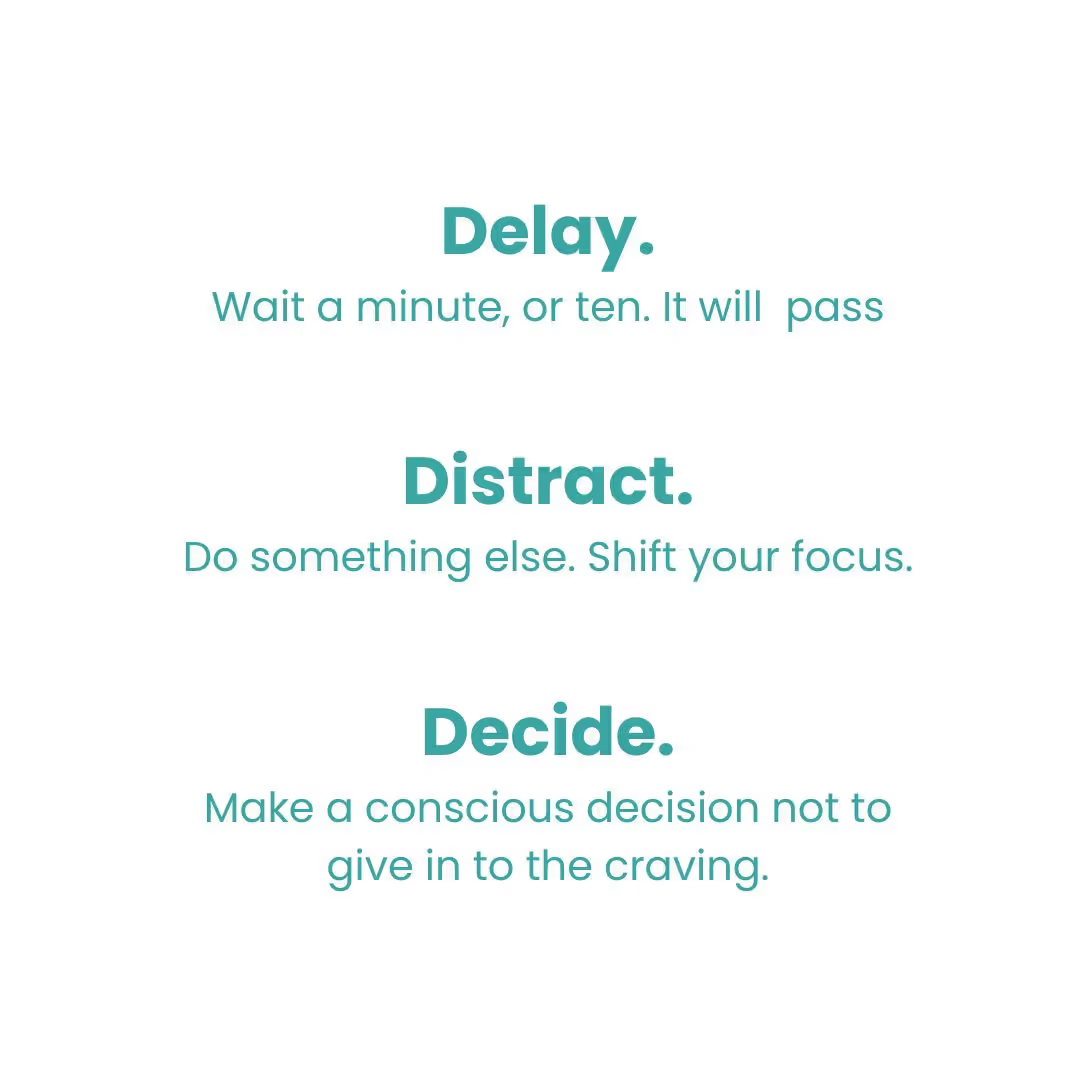
The 3Ds.pdf

Coping with Cravings
Cravings can be really challenging when you're trying to reset your relationship with alcohol, or any other substance, and can come out of nowhere when you least expect them, or appear at the familiar time when you were used to picking up a drink or other substance. They can feel intense too. The good news is that they do lessen over the time, and in the meantime there are lots of strategies you can deploy to manage and get through them.
Read our factsheet for quick tips and tricks to help you stay on course.
Download the factsheet:
Coping with cravings - fact sheet.pdf
Preview:
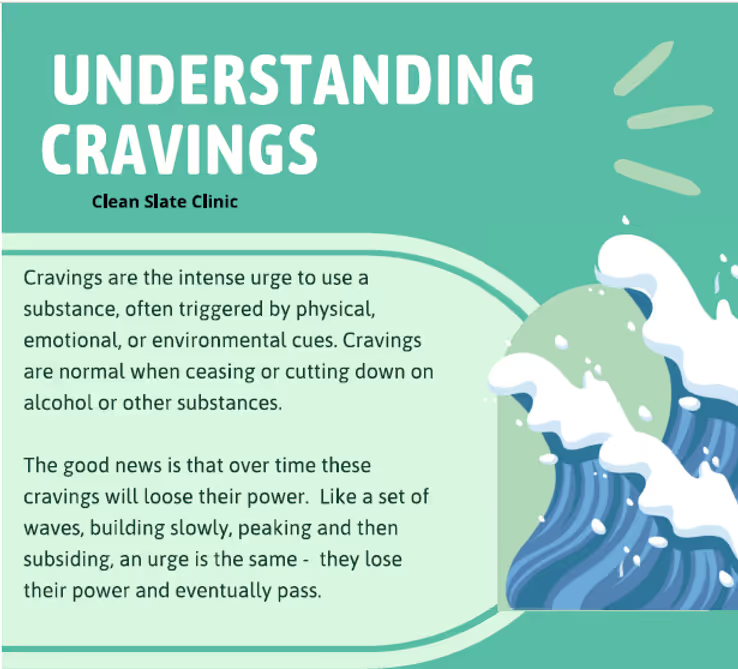
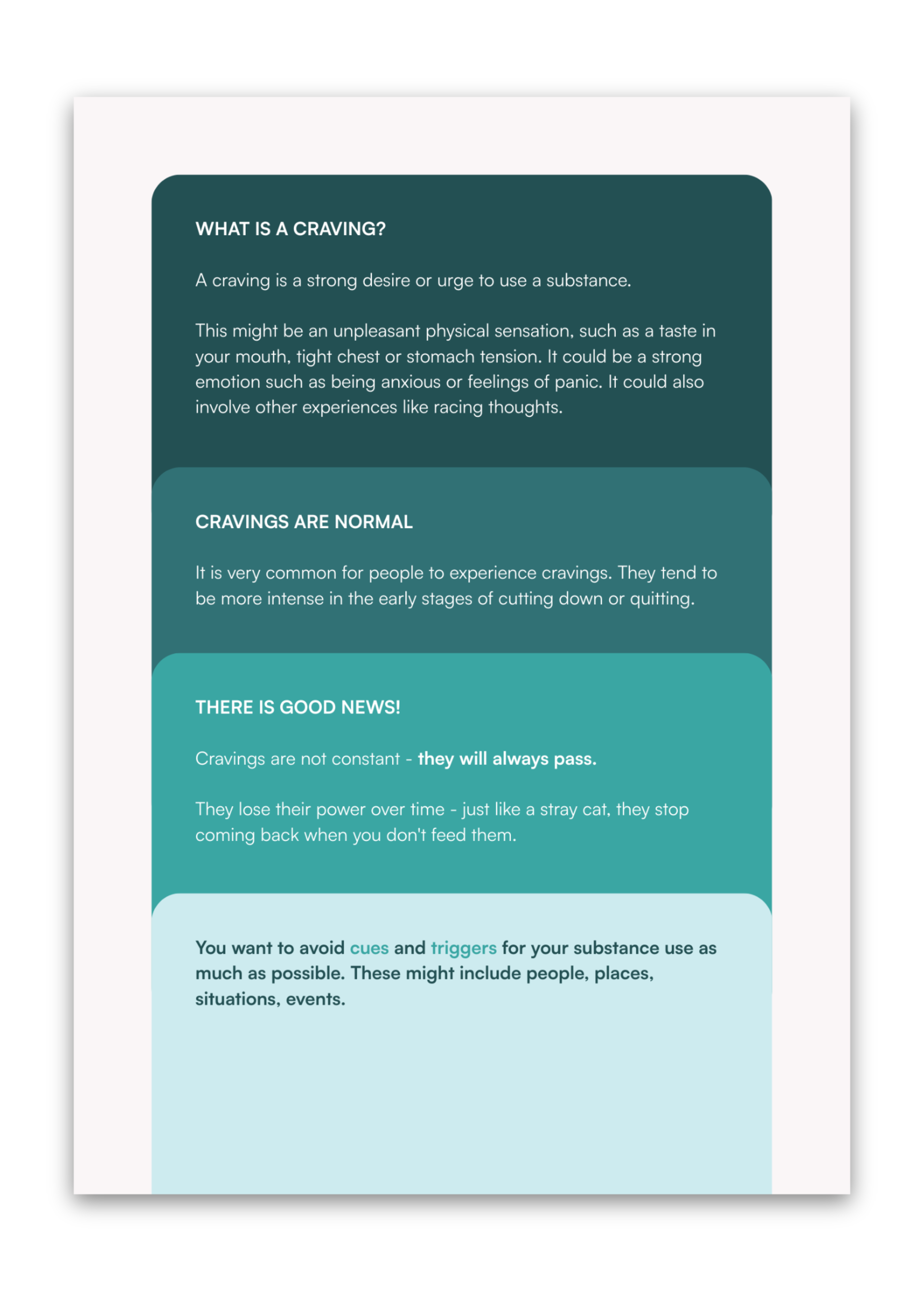
We also have a comprehensive guide below with everything you need to know about managing triggers and riding out the urge.
Download the guide:
Coping with cravings - guide.pdf
Preview:
.svg)





Ready to get started?





Subscribe


.avif)